
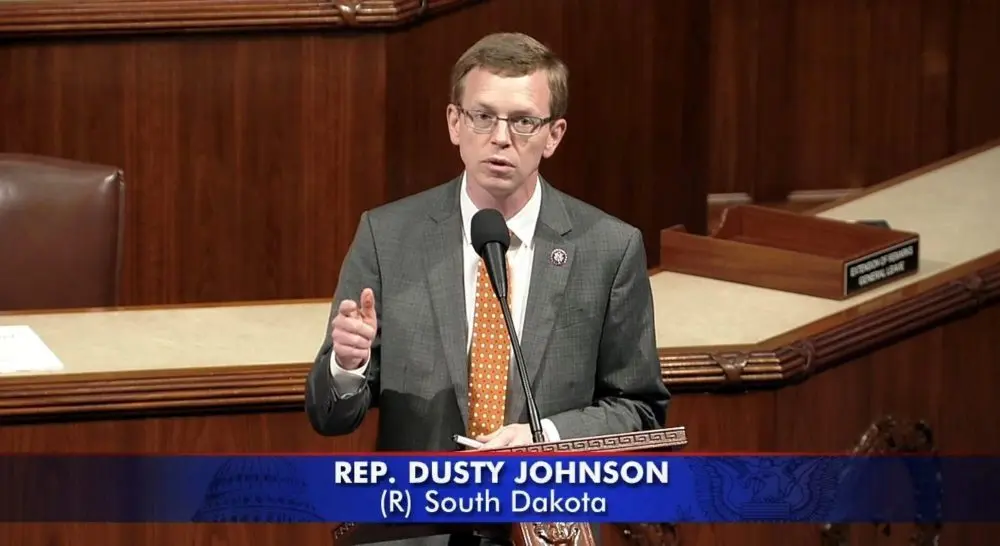
The U.S. House of Representatives unanimously passed the ePermit Act today, a bipartisan effort led by Representatives Dusty Johnson of South Dakota and Scott Peters of California. The legislation codifies President Trump’s Action Plan to modernize permitting technology across federal agencies, with the aim of reducing processing times for National Environmental Policy Act (NEPA) reviews and accelerating project approvals nationwide. The push comes as communities, businesses, and energy developers continue expressing concern that outdated permitting systems have slowed down essential infrastructure growth.
“It has become harder and harder to get any big project done in America,” said Johnson. “The same road project that can get approved in Germany in six months takes six years in America. America is full of innovators, creators, and builders. It’s time we let them build again, fueling economic growth and unlocking domestic energy production. I’m grateful the ePermit Act passed the House, and I hope the Senate acts soon so this can be the law of the land.” Johnson emphasized that the Act represents a pivotal step toward restoring efficiency and predictability, especially for industries that rely heavily on multi-agency environmental reviews.
“Passing this bill out of the House represents a major breakthrough in our effort to finally modernize an outdated permitting system,” said Peters. “Today’s progress is a clear sign that Congress can still come together to solve real problems; let’s build on this momentum, digitize the permitting process, cut needless delays, and get this bill across the finish line.” Peters noted that technological upgrades have long been recognized as essential to cutting down paperwork, improving accessibility, and addressing concerns from federal auditors and stakeholders alike.
Committee on Natural Resources Chairman Bruce Westerman echoed those points. “The ePermit Act modernizes an outdated system and establishes a streamlined, electronic permitting framework that will reduce red tape and increase efficiency across federal agencies,” said Westerman. “By transitioning to digital permitting, we can cut down on delays, enhance coordination and provide applicants with clearer, more predictable timelines. I applaud Representative Johnson for leading this bipartisan effort to bring permitting into the 21st century.” Westerman said improved coordination between agencies is particularly important where multiple approvals overlap, such as energy, transportation, and environmental restoration projects.
Support also came from the Council on Environmental Quality. “Modernizing the environmental review and permitting process will enable the United States to meet critical infrastructure needs, secure affordable and reliable energy, and fuel economic growth,” said Katherine Scarlett, Chairman, Council on Environmental Quality. “The administration welcomes congressional action to leverage technology to accelerate and simplify the permitting process across the Federal government, building on the accomplishments set in motion by President Trump’s Memorandum Updating Permitting Technology for the 21st Century – such as CEQ’s Permitting Technology Action Plan.” Scarlett emphasized that this shift is meant to improve environmental outcomes by ensuring clearer documentation, more consistent data, and more transparent public engagement.
The private sector also weighed in with strong support. “Technology and transparency are key pieces of meaningful permitting reform to let America build,” said Jeremy Harrell, CEO, ClearPath Action. “Today’s House vote reiterates bipartisan support for streamlining reviews in a way that balances speed and safety. We look forward to the Senate taking up the ePermit Act this Congress.” Harrell pointed out that permitting delays have had a measurable impact on timelines for clean energy deployments and modernization of the power grid.
Housing organizations highlighted the downstream effects on affordability. “NAHB urges House passage of the ePermit Act, introduced by Reps. Dusty Johnson (R-S.D.) and Scott Peters (D-CA),” said Buddy Hughes of the National Association of Home Builders. “This legislation would address housing affordability challenges by improving and expediting the environmental review and permitting processes. Permitting roadblocks delay housing projects and raise construction costs. The ePermit Act will bring clarity, efficiency, and certainty to the permitting process by requiring the use of electronic permitting platforms.” Hughes noted that digital systems could help reduce bottlenecks that have contributed to elevated construction costs over the past decade.
Chris Barnard of the American Conservation Coalition Action added that environmental progress depends on modern tools. “It’s no secret that the current permitting process remains a major barrier to deploying the projects needed to secure America’s energy and environmental future,” said Barnard. “By embracing today’s technology, we can modernize the permitting system and accelerate project approvals through greater efficiency and transparency. The American Conservation Coalition Action and its members across the country commend this effort to bring environmental review into the 21st century.”
Engineering firms also expressed strong backing for the change. “The American Council of Engineering Companies, the business voice of the nation’s engineering industry, supports passage of H.R. 4503, the ePermit Act and applauds Representatives Dusty Johnson (R-S.D.) and Scott Peters (D-CA) for their leadership on this important bipartisan legislation. The ePermit Act will modernize how federal agencies use technology to facilitate more efficient and timely federal permitting decisions. If passed, the bill will help to cut red tape by enhancing transparency, improving stakeholder engagement, and facilitating efficient interagency collaboration.”
Johnson first introduced the measure in July, and the House Natural Resources Committee advanced it in November. Its momentum reflects a growing bipartisan recognition that slow, paper-based systems have hindered project development across key sectors.
The current permitting framework often struggles to keep pace with modern demands. Review timelines can stretch for years, with root causes tied not to environmental questions but to outdated workflows, extensive paper documentation, limited transparency, and inconsistent interagency coordination. Such challenges have contributed to litigation, confusion among applicants, and costly project delays.
The ePermit Act aims to resolve these issues by directing federal agencies to adopt a unified digital permitting platform. The approach is designed to improve visibility for applicants, reduce paperwork, improve record management, and support faster, more predictable decision-making across the federal government. The legislation now awaits Senate consideration, where supporters hope continued bipartisan momentum will move it closer to final passage.