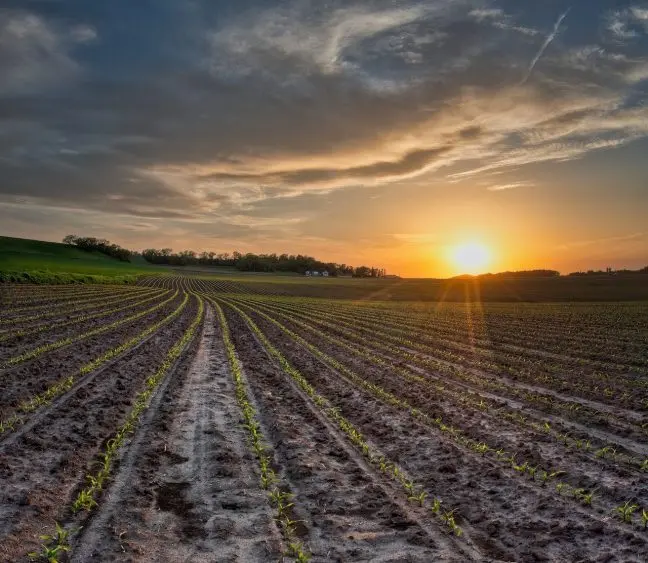
(LAMBERTON, MN) — Spring planting across southern Minnesota has unfolded in much the same rhythm as last year — early field access, good seedbeds and farmers that wasted no time getting the crop in the ground. The difference in 2026 has been the temperature gauge. A cooler May has slowed emergence and a stretch of mostly dry weeks has the southwest part of the state watching the sky for the next rain.
That’s the read from Jeff Strock, Professor with the University of Minnesota Southwest Research and Outreach Center in Lamberton.
“We’ve got similar conditions where we had great planting conditions early on. Farmers got out into the field, got started getting things planted, and we’ve had some cooler temperatures than last year,” Strock said. “Emergence has been a bit on the slower side.”
The good news, he added, is that things have started moving fast. “Just from the last four days, from Saturday to today, all of a sudden the beans have started emerging, you can start looking across cornfields, and they’re just starting to turn green. All in all, early season things are looking pretty good.”
A Dry Stretch — But Not All Bad
While the U.S. Drought Monitor shows dryness creeping into southwest Minnesota, Strock said it’s not yet time to hit the panic button. The top 12 to 18 inches of the soil profile is on the dry side after about three weeks without a steady rain, but moisture is holding deeper down.
“We know that there’s pretty adequate soil moisture deeper in the soil profile, you know, down that three, four feet deep,” he said.
And he says the dry topsoil may actually do the crop some favors heading into a forecasted warmer summer tied to a developing Super El Niño pattern — which Strock noted typically translates to warmer, but not necessarily drier, conditions for the upper Midwest.
“The drier surface conditions right now are actually probably going to help the crop. It’s going to force those plants to look for water, and they’re going to shoot those roots deeper into the soil profile to be able to tap into that deeper soil moisture,” Strock explained. Those deeper roots, he said, will help carry the crop through any hot, dry stretches later in the summer.
Moisture Management Starts with Residue
With the crop already in the ground, options to conserve moisture are largely limited to what’s on the surface. Strock pointed to tillage management — particularly the strip-till and no-till systems already common across the region — as the most effective lever growers have right now.
“More residue really helps reduce evaporation of any of the soil moisture that’s there,” he said. His own research on cover crops shows a similar benefit: stored moisture in the soil, plus a protective residue layer that slows evaporation once the crop is terminated. “Anytime we can kind of get more moisture in the ground and minimize evaporation, that’s a really good thing.”
Watch the Plant, Then Act
When it comes to in-season fertility, Strock said the crop itself is one of the best diagnostic tools a grower has — especially in a year when rainfall could be spotty and nitrogen losses could be uneven across the field.
“The easiest thing that they can do is just watch the crop, pay attention to the crop, look to see, does it start to get that yellow tint to it,” he said. A 12-inch or two-foot soil sample remains the gold standard for checking nitrate levels, but plant symptoms can flag when a side-dress — or, in wetter conditions, an aerial application — is warranted.
The same head-on-a-swivel approach applies to weeds, diseases and insects. Strock urged producers to scout regularly, stay in close contact with their agronomists and watch especially for late-season pests like soybean aphids.
For now, his message to Minnesota farmers is a steady one. “Sit back and do what you can out there. Pay attention to your crop and watch it grow,” Strock said, “and make sure eventually you get that combine tuned up and ready for fall.”
***AUDIO*** Hear the full conversation with Jeff Strock below: