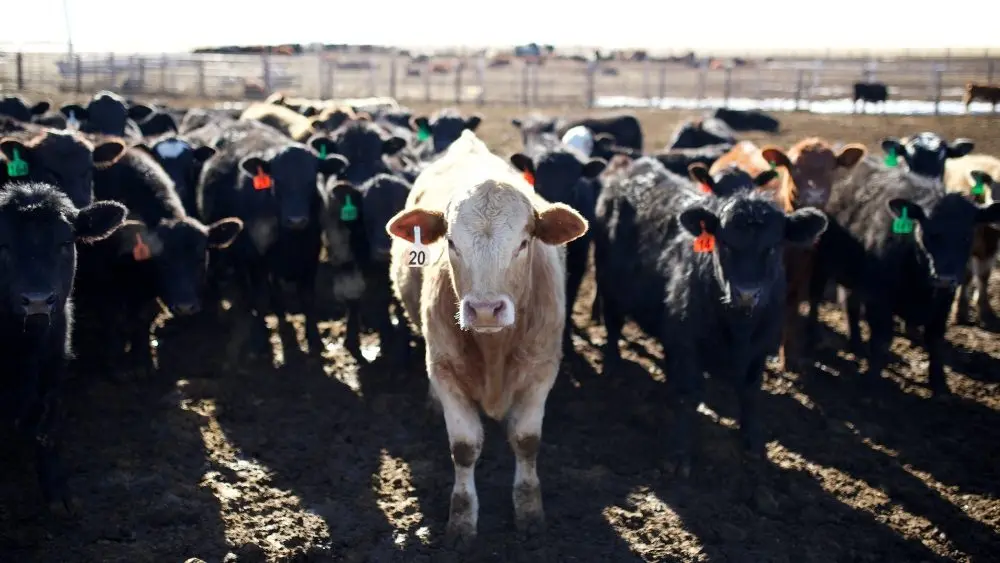

(FORT MORGAN, CO) — Cargill has officially locked out roughly 1,700 employees at its beef processing plant in Fort Morgan, Colorado, escalating a labor dispute that has kept the facility dark for nearly a month — and sending cattle futures sharply lower Thursday as headline-driven algorithms triggered a wave of selling.
Reuters reports that the lockout came after workers voted to reject Cargill’s contract proposal and the company stopped paying employees on Wednesday, according to Teamsters Local 455, which represents the Fort Morgan workforce. Cargill said it had halted cattle slaughtering at the plant since April 23rd and had continued paying workers throughout that period, but ended payments after the contract was voted down.
“This was not the outcome we wanted,” Cargill said in a statement, calling its offer a fair deal representing an estimated $33.4 million investment in employees.
For those who follow the cattle markets closely, the Fort Morgan situation was hardly a surprise. The plant has been offline for four weeks. What was new Wednesday was the official escalation — and the market’s sharp reaction to it. Brad Kooima, market analyst with Kooima Kooima Varilek out of Sioux Center, Iowa, joined Susan Littlefield on Thursday’s Cattle Chatter to put the futures sell-off in context.
“I think anybody that tries to know something has been very, very much aware that Fort Morgan has been dark for four weeks,” Kooima said. “Most of us thought, ‘So what else is new?’ — we just got done making all-time new record highs without them.”
Kooima pointed to algorithmic trading as the reason behind Thursday’s sharp move lower. “These headline-reaction algorithms react to a certain phrase, a certain collection of words, and it’s an automatic trigger to sell,” he said.
From a supply standpoint, Kooima said the cattle market can absorb Fort Morgan’s absence. “There isn’t a single plant that’s killing at max potential, that max efficiency — not even close,” he said. “We have the ability to kill the available supply, even with Fort Morgan dark.” Cargill confirmed it has been redirecting cattle to other processing facilities.
Still, Kooima acknowledged a deeper concern lurking beneath the surface. “With the packer margins the way they are, this probably is not sustainable,” he said, raising the question of whether Fort Morgan could become another casualty in a beef processing sector already under severe financial strain.
“Are we going to have another casualty in terms of having another packer close? That’s the worry.”
Fort Morgan’s troubles are not isolated. This spring, some 3,800 workers at JBS’s beef plant in Greeley, Colorado — about 60 miles to the west — went on strike over pay and working conditions. JBS reached a tentative agreement with those workers last month. Meanwhile, Tyson Foods closed its beef plant in Lexington, Nebraska last fall and reduced operations at a Texas facility, cutting thousands of jobs as it contends with shrinking cattle supplies.
The backdrop is an industry caught in a historic squeeze. U.S. beef demand has been strong, pushing prices to all-time records this year, but the nation’s cattle herd is the smallest in 75 years. Meatpackers are processing fewer head and absorbing heavy losses in their beef divisions because soaring cattle costs have outpaced the gains from higher meat prices.
President Trump has accused meatpackers — including Cargill and JBS — of driving up beef prices through collusion and directed the Department of Justice to investigate. The administration had also signaled it may issue an executive order aimed at alleviating domestic beef shortages, which markets have widely interpreted as a potential easing of tariffs on Brazilian beef imports. POLITICO reported this week that the plan is reportedly on hold indefinitely, and possibly entirely.
Kooima said that uncertainty around the executive order has adding to selling pressure. “There’s a fair amount of disagreement within the administration officials about whether completely taking the quota system away or relaxing the tariff with Brazil is really appropriate or not,” he said. He also questioned whether any tariff relief would meaningfully boost U.S. supply, given logistical limits on how much Brazilian beef can actually flow into the country.
Beyond Fort Morgan and Washington policy noise, Kooima flagged a structural shift in speculative positioning that he said may be the more significant force pressing on cattle futures.
“The funds that had near-record long positions in the June contract — as they started to roll out, they are not replacing their length in the August or October,” he said. “Metaphorically, the fund is taking their ball and going home. They don’t want to play in this stuff where we’ve got to worry about Iran, crude oil prices, whether there’s a new screwworm or not, what’s Trump gonna say next.”
June live cattle were trading around $249 Thursday, with the cash market running approximately $260–$261 — roughly $4 to $5 lower than the prior week. August cattle were sitting below $240. Kooima said he had expected the market to stabilize before Thursday’s session compounded recent losses.
“I don’t like the way it feels at all,” Kooima said. “This chart formation today is ugly. It projects another $10 to $12 lower. I hope I’m wrong.”
He urged producers who haven’t yet done marketing work to act carefully. “I hope people have listened — we’ve talked about being careful and being prudent here for a while,” Kooima said. “A combination of this uncertainty is not helping the market at all.”
If the cash market can hold, Kooima said, there is a path to stability. “If we can sustain this cash market here for a while yet — which I believe we can — it should stop the bleeding, unless we get something wonky out of Washington or screwworm or something else.”
***VIDEO*** Watch the full conversation with Brad Kooima on this week’s episode of Cattle Chatter below: