American agriculture has long been the tip of the spear in global trade disputes, and policy analyst Al Tank says that isn’t changing anytime soon — but what is changing, fast, is the world those farmers are selling into.
“The world order has changed, and it’s not going back,” Tank said in a recent interview on Agriculture of America. “We have to live in that paradigm.”
During our conversation, Tank laid out a case for why U.S. agriculture can no longer rely on the markets and trade relationships it has counted on for decades — and what farmers and policymakers need to do about it.
China: Hope Is Not a Strategy
Our conversation with Tank came days after the White House released a fact sheet from a Trump-Xi summit claiming $17 billion per year in U.S. agricultural purchases through 2028, along with an earlier pledge of 25 million metric tons of soybeans.
Tank’s read: be skeptical.
“We’re more of a supplier of last resort to the Chinese going forward, as compared to being a primary supplier that we really want to be or really need to be,” he said.
His reasoning goes back to phase one and phase two of the first Trump administration’s China trade deal. Phase one saw China fulfill roughly 80 percent of its agricultural purchase commitments. Phase two? “They bought zero,” Tank said flatly.
The deeper problem, he argues, isn’t Chinese bad faith alone — it’s that the U.S. has no real enforcement mechanism. Congress allowed Trade Promotion Authority to lapse more than a decade ago, leaving the country unable to negotiate binding bilateral or multilateral trade agreements.
“There’s no commitments. There’s no teeth. That’s what we have,” according to Tank.
Meanwhile, the rest of the world is locking in binding deals. The European Union just ratified the long-stalled Mercosur agreement with Brazil, Argentina, Uruguay, and Paraguay after 25 years of negotiations. Canada has 15 bilateral trade agreements ratified by its parliament. China is deepening economic ties across the South America. “They’re putting systems in place to put teeth into these processes,” Tank said. “We have not been doing that, and that’s really a shortcoming on us.”
BRICS: The Biggest Threat Most Farmers Don’t Fully Reckon With
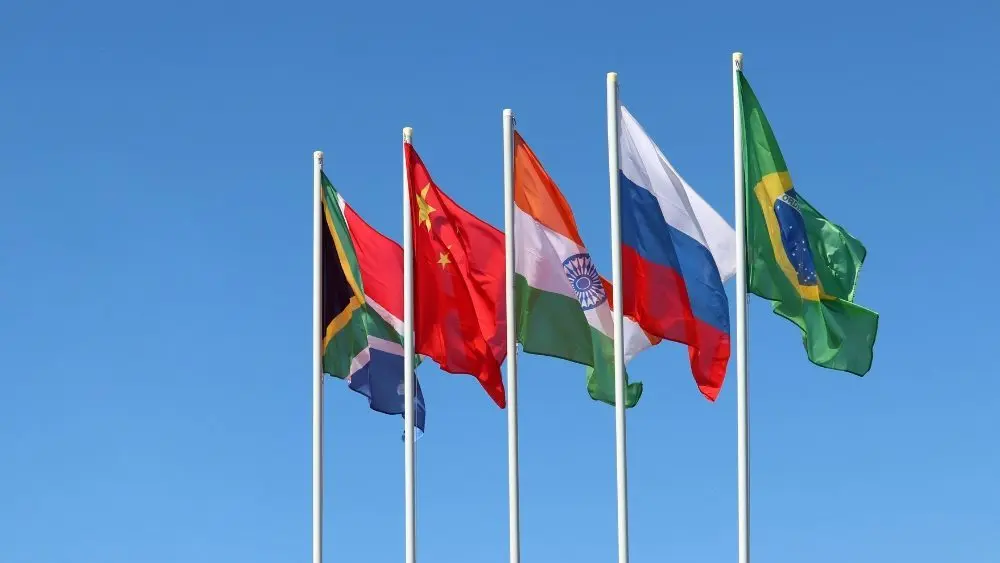
If there’s one issue Tank wants producers to take seriously, it’s BRICS — the economic coalition of Brazil, Russia, India, China, South Africa, and nine additional member nations.
“BRICS for American agriculture is the most important issue, really, that we face,” he said.
The reason starts with soybeans. Brazil now commands roughly 75 percent market share of soybean exports to China. And the infrastructure underpinning that shift is staggering: China has been pouring investment into South American ports, rail lines, and logistics networks specifically designed to route commodities directly to Chinese buyers — bypassing the Panama Canal and shaving 10 to 14 days off transit times.
“They’re using what I like to call a carrot approach,” Tank said. “They’ve changed the entire infrastructure. They’ve changed the entire reliance with regard to how and what is done in trade.”
The implications stretch beyond commodities. BRICS nations are also actively working to reduce dependence on the U.S. dollar in global trade — a shift already visible in how petrodollar flows are evolving in the Middle East. “That’ll have huge implications on our ability to be competitive,” Tank said.
USMCA: The Most Urgent Issue on the Calendar Right Now
With all the focus on China, Tank says farmers may be underestimating a deadline that’s right around the corner: the USMCA review, due July 1st.
Mexico is the number one export destination for U.S. agricultural products. Canada is number two. Together they outrank every other trading partner, including China, Japan, and South Korea.
“We need to make sure we continue that,” Tank said. “Can we improve it? Yes, but we have to continue it. That’s where you first start — and that’s July 1st.” He expressed concern that the current administration has signaled indifference toward the agreement’s continuation, at a moment when Canada-U.S. trade tensions are already elevated.
The Path Forward: New Molecules, New Coalitions, New Thinking
Tank is not all doom and gloom. He sees a real opportunity for American agriculture — but only if the industry is willing to change what it grows, how it sells, and how it fights for votes in Washington.
On the production side, he argues the industry needs to pursue new value-added markets with the same ambition that drove the ethanol and biodiesel industries. “We have to create a new molecule,” he said. “Think about where ethanol took us. We have to think about that new paradigm.” He points to global protein demand as the most powerful tailwind: “Protein, protein, protein is the driver. We’re really good at producing it. We have to be really good at producing it, adding value to it, and delivering it.”
On the political side, Tank warned that agriculture has burned bridges it can’t afford to leave charred. Deep cuts to SNAP — nutrition assistance programs — alienated the urban political coalition that agriculture needs to typically pass a farm bill or any meaningful food and trade policy. “You have to have those folks,” he said. “We need to rebuild that bridge back.”
His bottom line: the window to act is narrow, the July 1st USMCA deadline is immediate, and the structural forces reshaping global agriculture — BRICS, shifting currencies, Chinese-funded South American infrastructure — are only going to grow. “We can’t do what we’re doing today,” Tank said. “That I’m very confident of.”
***VIDEO/AUDIO: Watch or listen to the conversation with Al Tank below: